
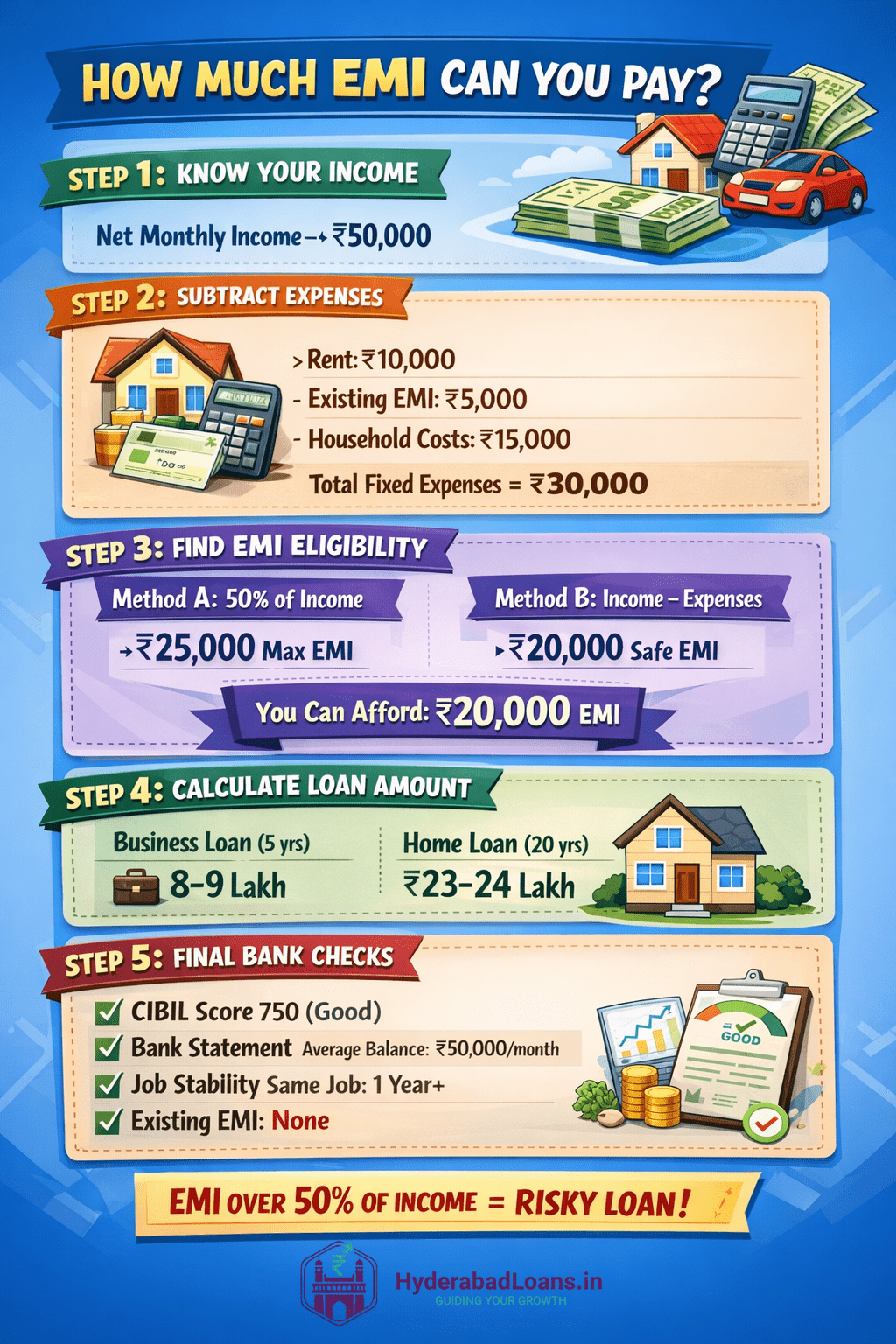
How Banks Verify Your Loan Eligibility: Step-by-Step Process Explained
Before approving any loan application, banks and NBFCs in India follow a structured and risk-based evaluation process. This loan eligibility verification process helps lenders assess whether a borrower can comfortably repay the EMI without financial stress. Understanding how banks verify your loan eligibility can help you prepare better, improve approval chances, and avoid last-minute rejections.
This cluster-supported blog is aligned with broader loan education topics and is especially useful for salaried individuals, self-employed professionals, and small business owners in Hyderabad and Telangana.
Why Loan Eligibility Verification Is Important
Loan eligibility verification is not about rejecting applications—it is about responsible lending. Banks must ensure that the borrower’s income, expenses, and credit behaviour support the proposed loan amount and tenure. This process also aligns with RBI’s responsible lending guidelines and protects borrowers from over-borrowing.
Most lenders use a combination of income checks, expense analysis, credit score review, and bank statement scrutiny to arrive at a final decision.
Step 1: Income Verification for Bank Loans
The first and most critical step is income verification for bank loans. Banks assess whether your income is regular, stable, and sufficient to service the EMI.
What Banks Check During Income Verification
- Net monthly income (after statutory deductions)
- Source of income – salary, business, or professional income
- Consistency of income credits
- Employer or business stability
General rule followed by banks:
Total EMIs (existing + proposed) should usually not exceed 40–50% of net monthly income. This ensures you have enough surplus for living expenses.
Salaried applicants applying for personal loans in Hyderabad may be asked for salary slips and Form 16, while self-employed applicants are evaluated using ITRs and financial statements.
Step 2: Expense & Existing EMI Assessment (FOIR Method)
Banks calculate your Fixed Obligation to Income Ratio (FOIR) to understand how much of your income is already committed.
Expenses Considered in FOIR
- Existing loan EMIs
- Credit card minimum dues
- House rent (if applicable)
- Estimated household expenses
Indicative FOIR Benchmarks
| FOIR Level | Bank Risk View |
|---|---|
| Below 40% | Strong eligibility profile |
| 40% – 50% | Acceptable, case-to-case basis |
| Above 50% | High risk, possible rejection |
Applicants with lower FOIR generally qualify for higher loan amounts and better terms, subject to overall credit assessment.
You can use an EMI calculator to estimate affordable monthly repayments before submitting a loan application.
Step 3: CIBIL / Credit Score Evaluation
Your credit score reflects your repayment discipline. It is a key component of the loan eligibility verification process.
How Banks Interpret Credit Scores
- 750 and above: Excellent approval chances
- 700–749: Good, usually acceptable
- 650–699: Average, may face stricter terms
- Below 650: Higher rejection risk
Banks also review credit reports for late payments, loan defaults, settlements, write-offs, and frequent recent enquiries.
Step 4: Bank Statement Analysis for Loans
Bank statement analysis for loans helps lenders understand real cash flow behaviour beyond income documents.
What Banks Look for in Bank Statements
- Regular salary or business income credits
- Average monthly balance
- Cheque bounces or ECS failures
- Unexplained large cash deposits
Healthy profile example:
Average monthly balance of ₹40,000–₹50,000, regular income credits, and no negative remarks generally indicate stable cash flow.
Step 5: Job or Business Stability Check
Banks prefer stability over short-term income spikes.
For Salaried Applicants
- Minimum 1 year in current job
- Total work experience of 2+ years preferred
- Employment with a reputed or stable organisation
For Self-Employed / Business Owners
- Business vintage of 2–3 years
- Consistent turnover and profitability
- GST and ITR consistency
Professionals and business owners may benefit from understanding business loan eligibility and assessment norms, which focus heavily on income stability and repayment capacity.
Step 6: Existing Loans & Overall Credit Exposure
Banks review your total credit exposure to assess repayment burden.
What Increases Risk Perception
- Too many active loans
- High credit card utilisation (above 30%)
- Multiple recent loan enquiries
In some cases, borrowers reduce EMI burden and improve eligibility through a loan balance transfer, subject to lender policies.
Final Bank Decision Logic
Banks typically arrive at a decision using a combined view:
Stable income + Low FOIR + Good CIBIL score + Clean bank statements = Higher approval probability
Applicants with fewer obligations and disciplined credit usage generally qualify more easily when they check loan eligibility before applying.
Quick Example: Ideal Loan Eligibility Profile
- Monthly income: ₹50,000
- Existing EMI: ₹5,000
- Household expenses: ₹15,000
- CIBIL score: 750
- Average bank balance: ₹50,000
- Job stability: Same job for 1 year
Indicative outcome: Eligible for a loan, subject to lender terms and conditions.